

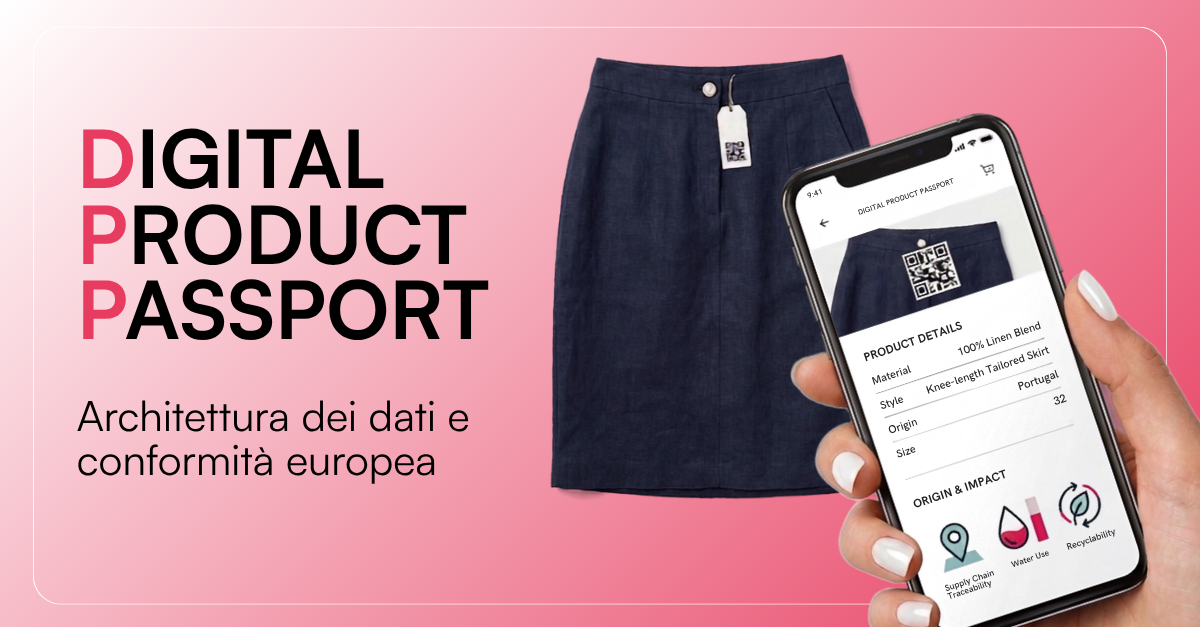
Digital Product Passport Fashion: The Data Architecture
Digital Product Passport (DPP) in Fashion: How to Design the Data Architecture for the EU Mandate
The countdown for the Textile and Apparel sector has officially begun. The European Commission's ESPR (Ecodesign for Sustainable Products Regulation) has introduced the Digital Product Passport (DPP), transforming supply chain traceability from a brand-enhancement element into a binding legal requirement for access to the single market.
For fashion brands, this transition is not merely a communication challenge or the application of a smart label to the finished garment. It is, in every respect, a complex data engineering and data architecture challenge.
Meeting the level of transparency required by the European Union means mapping and making accessible information that today is fragmented across dozens of different systems or, worse, locked inside the information silos of external suppliers (subcontractors). Before even choosing software or printing a QR Code, the real urgency for companies is understanding how to structure the data supply chain.
In this scenario of deep technical uncertainty, Advinser stands as the strategic technology partner capable of charting the course, supporting brands in architecture design and preparing the supply chain for European compliance. Read the deep dive here: /.NFT & /.DPP for Fashion.
What is the Digital Product Passport and What Data Does the EU Require?
The Digital Product Passport is a digital record accessible via a physical carrier on the garment (such as a QR Code or an NFC tag). While the use of digital tokens was previously seen primarily as a marketing tool—as we explored in our analysis on NFTs and authenticity in Fashion—today the DPP meets strict compliance criteria.
The information required by the EU, which corporate IT infrastructures must be able to aggregate, includes:
- Product Identification: Global unique identifiers (UIDs), SKUs, model descriptions, and production batches.
- Supply Chain Traceability: Geographic mapping of production sites, from raw materials (spinning, weaving) through to final packaging.
- Composition and Sustainability: Exact material percentages, presence of tracked chemical substances (REACH), and supply chain certifications.
- Circularity and End-of-Life: Detailed instructions for repairability, recycling, and end-of-use garment management.
The IT Manager's Perspective: Map the Course Before Integrating Systems
The main critical issue for an IT Manager is not purchasing a platform, but the data feed process. The information that will make up the DPP does not reside in a single database; it originates at different times and in different systems—from the PLM for technical data sheets, to the ERP for purchase orders, down to MES systems for the processing phases of external subcontractors.
If the company's IT architecture manages this data in a disconnected way, no software on the market will be able to generate a valid passport.
Advinser's distinct value lies precisely in its ability to act as a technological director. We do not provide a rigid application to install in the hope that it works; instead, we analyze your current flows, identify information gaps in your supply chain, and co-design the optimal integration infrastructure. We prepare your systems (ERP, PLM, and databases) to communicate with European standards, avoiding rushed investments in partial solutions.
Beyond Technology: The Certainty of Methodological Guidance
Tackling the ESPR Regulation requires skills that combine B2B IT with a deep knowledge of fashion manufacturing. As we also highlighted in our previous studies on how quality control addresses logistical challenges and customs duties, the fashion supply chain has unique dynamics that generic system integrators cannot understand.
Advinser provides Fashion Brands with a methodological and engineering guidance path:
- Technical Assessment: We analyze the state of your databases to understand where mandatory data resides and which data still needs to be extracted from suppliers.
- Taxonomy Definition: We help you standardize information coding—a crucial step to avoid formatting errors that would make the passport non-compliant at customs.
- Flow Engineering: We design the structure of information flows so that, when implementing decrees become strict, your corporate architecture is already natively prepared to generate digital passports automatically and securely.
Preparing the Company for the DPP: The Time to Act is Now
Postponing data flow design for the Digital Product Passport exposes the company to the risk of customs blocks, penalties, and a loss of international competitiveness. Digitalizing the supply chain requires structured planning that starts with the analysis of data currently available within company IT systems.
Advinser accompanies fashion brands through this transition, offering the engineering expertise needed to govern regulatory complexity, chart the correct path, and secure the future of production.
SECURE YOUR BRAND: DESIGN YOUR DIGITAL PRODUCT PASSPORT STRATEGY
Do not get caught off guard by European regulations and do not invest blindly in pre-packaged software. Tackle the DPP mandate starting from the foundations: a solid, secure data architecture tailored to your fashion supply chain.