

How to choose a MES Software: a practical guide for companies
Is your company ready for a MES?
Not every company needs a MES at the same time. Before evaluating solutions and vendors, it’s worth doing an honest internal check.
These are the signs that indicate the timing is right:
- You don’t know exactly, in real time, the production status of an order.
- Shop floor data exists but is scattered: Excel sheets, emails, whiteboards, disconnected systems.
- You struggle to respond quickly to customers about delivery times and order status.
- Scrap and rework are difficult to track and quantify.
- Quality depends too much on individual operators rather than standardized processes.
- You are growing and your current way of managing production doesn’t scale.
💡 You don’t need to have all these problems. Even two or three of these signs are enough to start considering an MES.
Define priorities before looking at software
One of the most common mistakes is starting the evaluation from the software itself. The risk is being guided by available features rather than the real problems you want to solve.
Before contacting any vendor, define internally:
- What is the most urgent problem to solve? (visibility, quality, traceability, energy efficiency…)
- Who will be the main users of the system? (shop floor operators, production managers, IT, executives)
- Which systems must the MES integrate with? (ERP, machines, quality systems)
- What is the estimated budget and the expected ROI timeframe?
- Do you have internal resources to manage the project, or will you need ongoing support?
Answering these questions will allow you to compare vendors on a like-for-like basis and avoid being sold features you don’t need.
Criteria for choosing the right MES software
Not all MES systems are the same. Here are the criteria that really make a difference:
Modularity
A good MES is not purchased all at once. Modularity allows you to start with the most useful module (e.g., production monitoring) and add quality, energy, or advanced planning later, as your organization evolves.
Integrability
The MES must communicate with your ERP, machines, and existing quality systems. Always ask for concrete examples of completed integrations, not just generic compatibility claims.
Configurability vs. customization
There’s an important difference: a configurable system adapts to your process rules without modifying the code. A system that requires custom development is more expensive, slower to implement, and harder to update. Prioritize configurability.
Support and guidance
MES implementation doesn’t end at go-live. Evaluate the level of post-implementation support: training, updates, and operational assistance.
How an MES is implemented: project phases
A well-managed MES project typically follows these phases. Timelines vary depending on company complexity and number of modules, but a basic implementation can go live in as little as 2–3 months.
- Process analysis and mapping
It always starts with an in-depth analysis of existing production processes: flows, roles, systems in use, and available data. Without this phase, you risk digitizing inefficiencies. - Requirements definition and configuration
Based on the analysis, the system is configured according to specific company rules: workflows, cost centers, quality parameters, automatic alerts. - Integration with ERP and machines
The MES is connected to other company systems. This is often the most delicate phase and requires specific technical expertise in both IT and OT (operational technology). - Testing, training, and go-live
Before the actual go-live, testing is carried out on real production scenarios. Operator training is essential: even the best software fails without adoption. - Continuous improvement
A MES is not a project with an end date. The data it collects over time helps identify new areas for improvement and continuously refine processes.
Mistakes to avoid when adopting a MES
Those who have already gone through a MES project know there are recurring pitfalls:
- Underestimating the initial analysis phase and starting configuration too early
- Trying to implement everything at once (modularity exists for a reason.. use it)
- Not involving operators from the beginning
- Choosing based on the lowest price
- Ignoring ERP integration
- Not defining success metrics
If you don’t know what you’re measuring, you won’t know if the project worked.
Advinser’s /.MES: modular, integrated, configurable
/.MES is built from direct experience with Italian manufacturing companies in fashion, food, furniture, faucets, glass, and packaging. It specifically addresses the challenges of digitizing production without disrupting the organization.
- Modular by design
Activate the first module in just a few weeks and build a complete system over time, following your company’s real priorities. - Configurable without coding
It adapts to your factory’s rules and processes without costly custom development. - Integrated by nature
It connects with ERP, SCADA, WMS, quality systems, and machines, creating a unified information ecosystem.
A concrete example: Rubinetterie Treemme, a leading Tuscan bathroom furnishings company, adopted /.MES to optimize processes and ensure consistent quality.
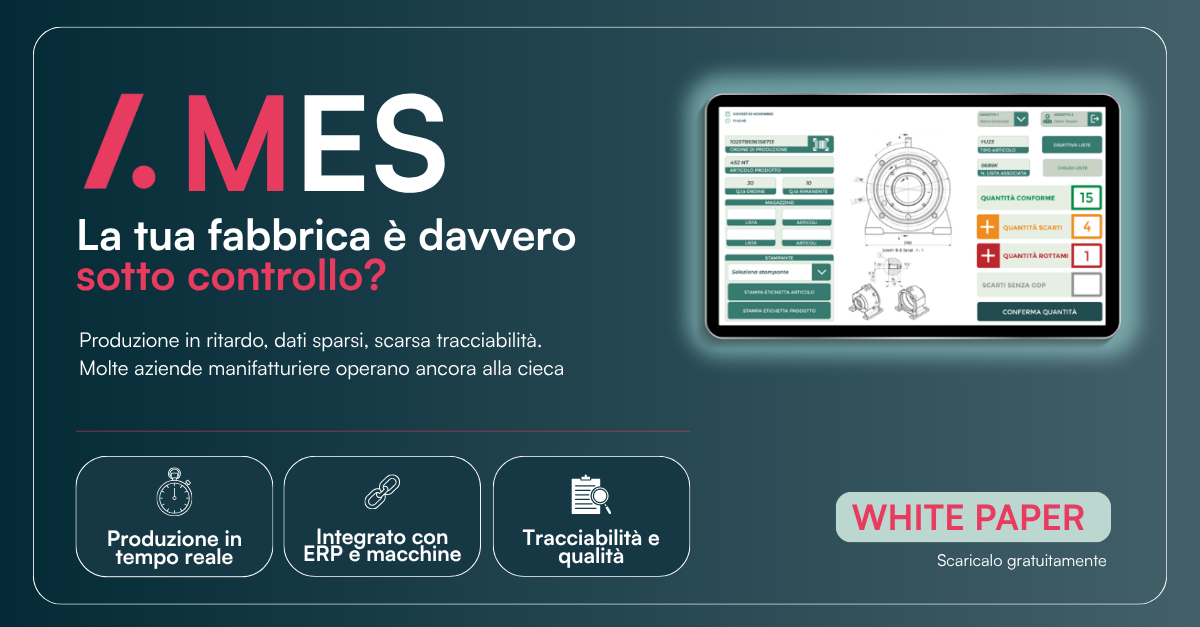
Download the White Paper: the Smart Factory guide
We’ve gathered everything you need to methodically evaluate the adoption of a MES in a downloadable document: key questions to ask vendors, features to assess, /.MES modules, and measurable benefits.
It’s free, requires no commitment, and is written for those who need to make real decisions, not just understand what a MES is.