

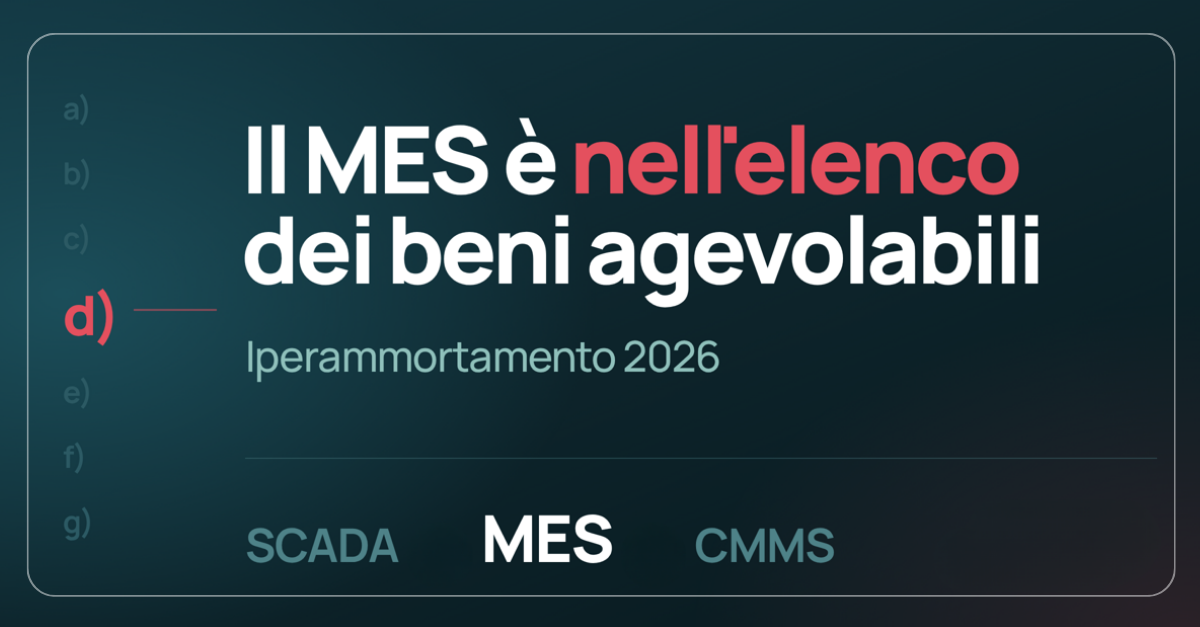
MES among the assets eligible for the 2026 tax incentive
Is MES software eligible for Italy's 2026 tax incentive?
Yes. Software for the management and coordination of production is listed among the eligible intangible assets in Annex V of Italian Law 199 of 30 December 2025, and MES systems are named explicitly. Being on the list is not enough on its own: conditions apply, and they have to be assessed case by case.
There is one point that is missed almost every time: the company does not have to buy a new machine as well. A plant that already has its equipment installed can consider the software investment on its own.
Who this is written for. If your group operates a manufacturing site in Italy, this is the incentive your Italian entity would claim, and production software falls inside its scope. The decision belongs to your Italian tax advisor, but the technical evidence sits with the plant, and that is the part we can speak about.
And one thing about us. We are not tax advisors and we do not issue technical appraisals. We install MES systems, and in that role we regularly find ourselves inside an incentive file. What we know well is a single thing, and it is what the second half of this article covers: which data you need to be able to produce when the appraiser asks for it.
MES is on the list
Annex V lists the eligible intangible assets. The entry covering a production management system is letter d), and it names MES explicitly, alongside SCADA and CMMS:
software, systems, platforms and applications for the management and coordination of production with a high degree of integration of service activities, such as in-plant logistics and maintenance (for example in-plant communication systems, fieldbus, SCADA systems, MES systems, CMMS systems...)
That is our translation of the Italian text, which names sistemi SCADA, sistemi MES, sistemi CMMS. It is not an extensive reading of the provision: MES is written into the list.
No new machine is required
This is the point that changes the picture for a plant that already has its equipment and is not planning to replace it.
The provision lists tangible and intangible assets together and asks the same thing of both: that they be interconnected to the company's production management system or to the supply network. It does not require the two investments to go together.
So a MES project can be assessed on its own. Assessed, not taken for granted: whether the incentive applies in your case is for your Italian tax advisor to establish, and it is worth asking before the order is signed rather than after.
The other conditions, briefly
They are not automatic, and they are not ours to govern. In short: the software must be new and instrumental to the business, it must be interconnected, the investment goes through a procedure with the GSE, the Italian public body that administers the scheme, and a sworn technical appraisal is required. Whether your project meets those conditions is for the tax advisor and the appointed appraiser to verify.
Of those conditions, only one depends on how the system is built and installed. It is also the one companies are least prepared for.
Interconnection: the part that concerns us
The appraiser does not look at the cable, he looks at the data. And he wants it over time, not only on the day of commissioning. In practice four things have to exist.
A stable identifier for every resource. It must always be clear which machine or which workstation a data point came from. This is where problems appear when everything passes through a single shop-floor PC acting as a funnel: the data arrives, but all of it carries the same signature.
A history with date and time. It answers the question "was this line connected in March?" without relying on memory. Data that is overwritten every shift is not a history.
The link between order and machine. It is the most effective evidence of exchange with the company systems: the order comes down from the ERP to the workstation, and progress data goes back up tied to that order and that resource.
The ability to extract all of it in readable form. A report the appraiser can look at, not a query he has to ask someone to run.
These are exactly the data a MES collects and keeps for its everyday work. The difference between a plant that has one and a plant that does not is not whether the data exists: it is that the first arrives at the appraisal with the evidence already in place, while the second has to reconstruct it after the fact, months into operation.
Frequently asked questions
Is MES software eligible for the Italian 2026 incentive?
Yes. MES systems are named explicitly in letter d) of Annex V to Law 199 of 30 December 2025, alongside SCADA and CMMS systems, among software for the management and coordination of production.
Does the company have to buy a new machine as well?
No. The provision treats tangible and intangible assets together and requires interconnection of both, without making the software conditional on the purchase of a tangible asset. Verification of the specific case remains with the tax advisor.
What does the system have to demonstrate for the appraisal?
That the exchange of data with the company systems is real and traceable: a stable identifier for each resource, a history with date and time, the link between order and machine, and an extractable report. This is the part worth setting up when the plant is designed, not on the day of the appraisal.
References: Law 199 of 30 December 2025, Annex V and Article 1, paragraphs 427 onwards. This article describes what a system needs in order to withstand the technical verification of interconnection. It is not tax advice: assessment of the incentive in your case rests with your Italian tax advisor and the appointed appraiser.
Considering a MES project and want to reach the appraisal with the evidence ready?
We look at what your plant produces today and what needs to be documented.