

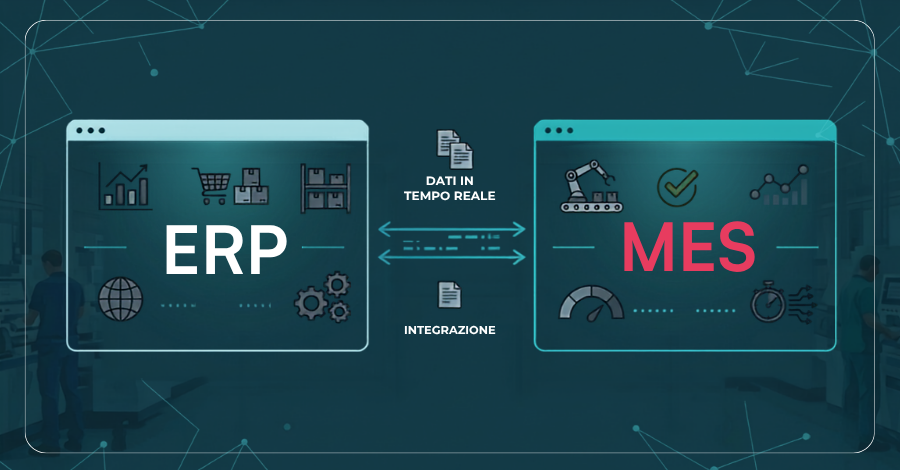
MES vs ERP: differences, integration, and when you need both
"We Already Have an ERP. Why Should We Invest in a MES Too?"
It's the most common question we hear from companies evaluating the digitalization of their production processes—and it's a fair one. If you've already invested time and budget in an ERP system, adding another platform may seem redundant.
It isn't.
ERP and MES solve different problems at different levels of the organization. Understanding the difference is the first step in determining whether you need one, the other, or both.
What Is an ERP? The Company's Management Brain
An ERP (Enterprise Resource Planning) system manages business processes at a strategic and administrative level: customer orders, procurement, accounting, inventory, invoicing, and high-level production planning.
An ERP answers questions such as:
- How many orders do we need to deliver this month?
- What is the current availability of raw materials in stock?
- What margin do we expect on this job order?
- When should we reorder a component?
The ERP's time horizon is typically measured in days or weeks. It plans, schedules, and records performance, but it operates at a level of abstraction that doesn't capture what is happening minute by minute on a specific machine at a specific moment.
What Is a MES? Real-Time Production Execution
A MES (Manufacturing Execution System) operates at a completely different level: real-time operational execution directly on the shop floor.
A MES answers questions such as:
- What is the exact status of this production order right now?
- What is the OEE of this production line over the last two hours?
- Did this batch generate scrap? On which machine and under which operating conditions?
- Has the operator completed the required production phase?
The MES time horizon is measured in minutes or seconds. It does not plan production—it executes, monitors, and documents it as it happens.
For a deeper technical overview, read → MES Software: What It Is, How It Works, and What It Is Really Used For.
Why companies often need both
An ERP without a MES plans production based on estimates rather than actual shop-floor data. It knows what should happen in production, not what is actually happening.
The typical result: production plans that diverge from reality, inaccurate performance reporting, and decisions based on outdated information.
A MES without an ERP, on the other hand, has perfect visibility into what happens on the shop floor but remains disconnected from the rest of the business. It does not know what customers have ordered, it is not connected to accounting, and it does not communicate with procurement processes.
The real value emerges when the two systems work together:
ERP plans → MES executes and verifies → ERP receives real production data
A practical example:
The ERP generates a production order for 1,000 units with a five-day deadline. The MES receives the order, assigns it to the correct production line, monitors progress in real time, alerts managers if production speed is insufficient to meet the deadline, and, once production is complete, sends actual results back to the ERP: 980 conforming units, 20 rejected units, and actual production time.
The ERP then updates inventory, invoicing, and future planning based on real data rather than estimates.
Without this dialogue, the 20-unit shortfall is discovered only after production is complete—when it is too late to take corrective action.
When an ERP alone is enough
Not every company immediately needs a MES.
If production is relatively simple, low-volume, managed through a limited number of departments, and can be easily controlled through direct supervision, a well-configured ERP, possibly with basic manufacturing modules, may be sufficient for a period of time.
Signs that an ERP alone may still be enough include:
- Fewer than 15–20 employees in production.
- Simple manufacturing processes with limited variability.
- Low requirements for detailed traceability (batch, machine, process parameters).
- No strict regulatory requirements regarding quality or traceability.
When a MES Becomes Necessary
The turning point usually comes when one or more of the following factors emerge:
Increasing Production Complexity
More production lines, more departments, and more product variants make visual management and manual oversight increasingly ineffective.
Traceability Requirements
Industries such as food, fashion, and automotive require detailed batch traceability that an ERP alone cannot provide at the required level of granularity.
The Need to Improve OEE
If you cannot identify where production inefficiencies occur, you cannot improve them. A MES makes those inefficiencies visible.
Business Growth
What works with 20 production employees often becomes unmanageable with 80 if processes remain largely manual.
Industry 5.0 Incentives
Many Industry 5.0 incentive programs require machine connectivity and structured data collection capabilities that a robust MES can reliably provide.
Where Does Business Intelligence fit In?
At this point, another question often arises:
If I already have both an ERP and a MES, do I still need Business Intelligence?
The short answer is yes, but for a different purpose.
ERP and MES systems generate large volumes of data from different sources. Business Intelligence (BI) is the layer that brings those data sources together, connects them, and transforms them into actionable insights.
For example, a BI dashboard can display job-order profitability (ERP data) alongside OEE and scrap rates (MES data) in a single view.
Without BI, ERP and MES often remain separate information silos, even if they are technically integrated.
How to Manage ERP-MES Integration
If you already have an ERP and are evaluating a MES, integration between the two systems is the most critical aspect of the project and the area where supplier selection deserves the greatest attention.
Questions to ask any MES vendor:
- Have you already integrated with our specific ERP system and version?
- Is the integration bidirectional, or does data flow only one way?
- Which specific data are exchanged, and how frequently?
- What happens if communication between the two systems is interrupted?
For a complete guide, read → How to Choose a MES Software Solution: A Practical Guide for Manufacturers.
Advinser /.MES: Designed to Integrate, Not Replace
/.MES is not designed to compete with your ERP system. It is designed to complement it.
It integrates with the most widely used ERP platforms among Italian manufacturers (including Zucchetti, AS/400-based systems, SAP, Microsoft Dynamics, and others) through connectors designed for bidirectional, real-time data exchange.
The goal is not to duplicate ERP functionality, but to fill the operational execution layer that ERP systems, by nature, cannot manage in detail.
If you are evaluating how a future MES could work alongside your current ERP, this is the most practical starting point for a serious assessment, not abstract functionality lists, but an analysis of your specific IT ecosystem.
FAQ – MES and ERP
Can I use only an ERP to manage production?
For simple, low-volume manufacturing environments, yes, especially if the ERP includes basic production modules.
However, as complexity, production volumes, and traceability requirements increase, the ERP's limitations become evident. It lacks real-time visibility into what is actually happening on the shop floor.
Does a MES replace an ERP?
No.
The two systems are complementary, not alternatives. A MES does not manage accounting, procurement, or invoicing. Its focus is production execution and monitoring.
How complex is ERP-MES integration?
It depends on the ERP system and the quality of the available connectors.
Widely adopted ERP platforms with documented APIs (such as SAP, Microsoft Dynamics, and Zucchetti) typically allow faster integrations. Highly customized or legacy ERP systems may require bespoke development.
Should I replace my ERP to simplify MES integration?
Almost never.
A well-designed MES should integrate with the existing ERP through connectors or APIs without requiring replacement of the management system.
Replacing an ERP is a separate project with significantly higher costs and timelines than a MES integration.
Where should companies start if they have neither a MES nor a structured ERP?
In most cases, the starting point is the ERP, since it manages core administrative and commercial processes.
A MES is typically introduced later, when production complexity reaches a level that justifies the investment.