Industry 4.0 interconnection: what it takes and how to prove it
Industry 4.0 interconnection: what it takes and how to prove it
A machine is interconnected when it exchanges data with the factory's information systems, the ERP, planning, the MES, and when it can be identified unambiguously, so you always know which machine a piece of data came from.
Put that way it sounds obvious. In practice it is the requirement people are least prepared for, and not because the machine is not connected: because no record of the connection was kept.
Why it matters. Interconnection is one of the conditions for claiming hyper-depreciation on a machine. It is not an obligation: if you buy a machine that is not connected you are breaking no rule, you simply do not get the benefit. But if you want it, a technical appraiser has to certify it, and the appraiser needs evidence.
One thing worth knowing, because it is less well known: hyper-depreciation does not only cover machines. Production management software is among the eligible assets too, under different conditions from the ones described here. We wrote about it in Is MES software eligible for Italy's 2026 incentive? This article is about machines.
This is what we do: we connect machines and install the system that keeps a record of that connection. What follows is what we have learned doing it.
This article explains the difference between interconnection and integration, which is the most common misunderstanding, and above all which data you need to be able to produce.
Interconnection or integration? They are not the same thing
They sound like synonyms, and instead they are two distinct requirements, both of which must be met.
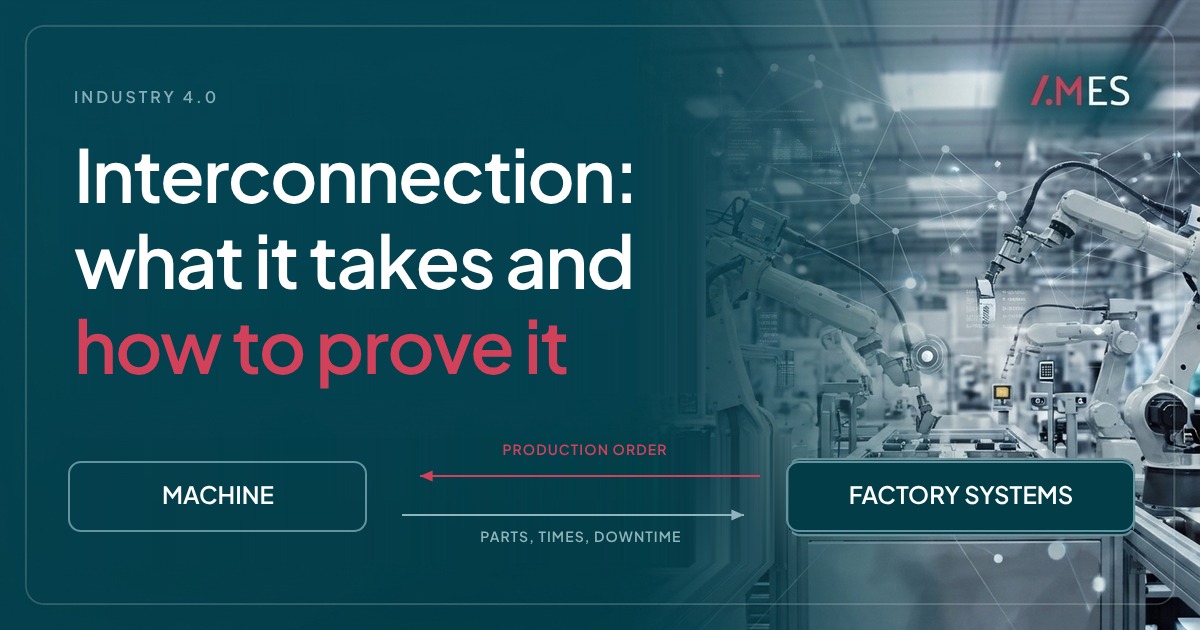
Interconnection: the machine exchanges data with internal systems. It receives the production order from the ERP and sends back parts produced, times and downtime. It faces the information systems.
Integration: the machine sits inside an automated flow. When it finishes the batch it notifies the warehouse, or it passes the part to the next machine with no one stepping in. It faces the flow of materials.
A milling machine that receives the order and reports progress is interconnected. The same machine that calls the AGV for collection once the part is done is also integrated.
The confusion is expensive at appraisal time: it is common to document the dialogue with the ERP well and take the rest for granted, convinced you have covered two requirements when you have covered one.
The characteristics the machine must have
There are five, and all five are required, plus at least two from a second list of three. They apply to production machinery and plant, which in Annex IV is the first of the four groups of assets.
All five are required:
- Control by CNC or PLC.
- Interconnection to factory information systems, with remote loading of instructions or part programs.
- Automated integration with logistics, the supply network or the other machines in the cycle.
- A simple, intuitive human machine interface.
- Compliance with the most recent safety, health and workplace hygiene parameters.
And at least two of these three:
- Remote maintenance, remote diagnostics or remote control.
- Continuous monitoring of working conditions and process parameters with dedicated sensor sets, and adaptability to process drift.
- Integration between the machine and the modelling or simulation of its own behaviour in the process, the digital twin.
The reference list for investments from 2026 is Annex IV to Law 199/2025. If you find content citing Annex A to Law 232/2016, it belongs to the previous regime.
The hard part: proving it
The proof of interconnection is not the connection itself, but the data it produced. And the appraiser wants that data over time, not just on the day of commissioning. Four things have to exist.
A stable identifier for every machine. It must always be clear which machine a piece of data came from. This is where problems start when the flow passes through a shop floor PC or a concentrator that acts as a funnel: the data arrives, but all of it with the same signature.
A history with date and time. It answers the question «was this machine connected in March?» without relying on memory. Data that is overwritten every shift is not a history.
The link between order and machine. It is the most effective proof of the dialogue with the systems: the order comes down from the ERP to the workstation, progress goes back up tied to that order and that machine. Whoever has this gets through the appraisal in half an hour.
The ability to export it all in a readable form. A report the appraiser can look at, not a query they have to ask someone to run.
These are exactly the data a MES collects and keeps for its daily work. The difference is that whoever already has it arrives at the appraisal with the evidence ready, whoever does not has to build it after the fact, when the machine has been running for months and reconstruction gets complicated. If you want to understand how a MES works, we wrote about it in what a MES is and how it works, and these are the same data the OEE comes from.
Four situations where you find out too late
The machine just writes a file. A file on a shared folder is a connection. Whether it is enough is for the appraiser to judge, and it depends on how the exchange is documented and how the machine is identified.
All the data goes through a single PC. It works for production, but if the machines cannot be told apart on the way out, unambiguous identification breaks.
The connection is there but leaves no history. This is the most frequent and most annoying case: the data exists, it gets used, and it gets overwritten.
The connection is unplugged later. It happens during maintenance or a layout change, and nobody puts it back. The evidence stops halfway.
Frequently asked questions
What are the requirements for Industry 4.0 interconnection?
Two, and according to Circular 4/E of 2017 they are necessary and sufficient: the machine must exchange information with internal or external systems through a connection based on documented, publicly available and internationally recognised specifications, and it must be uniquely identified, typically by an IP address, so that the origin of the data can be traced.
Is it enough for the machine to send data, or must it also receive it?
The requirement refers to exchange, and it also covers the case where planning or progress instructions come down from the system without that starting the machine. Read-only cases have to be assessed plant by plant: it is the least settled point in the whole matter.
Can an old machine become interconnected?
Technically yes: with sensors and network components an existing machine can start exchanging data and being identified. How worthwhile it is depends on what data the machine is able to expose: on very old plant you sometimes only get halfway.
How do you prove interconnection?
With the data the system has kept: the machine identifier, a history of the information exchanged with date and time, the link between production order and machine, and a readable report. This is why it pays to deal with the subject when the plant is being designed, not on the day of the appraisal.
References: the list of technical characteristics for investments from 2026 is Annex IV to Law 199/2025. The technical definition of interconnection commonly used is the one in Circular 4/E of 30 March 2017 from the Italian Revenue Agency and the Ministry of Economic Development, which the new legislation has neither reproduced nor expressly referred to. What you read here is technical information, not tax advice: assessing your own case remains a matter for your accountant and the appraiser.
About to buy a machine and want to reach the appraisal with the evidence ready? Talk to us: we look at what your shop floor produces today and what is missing.