

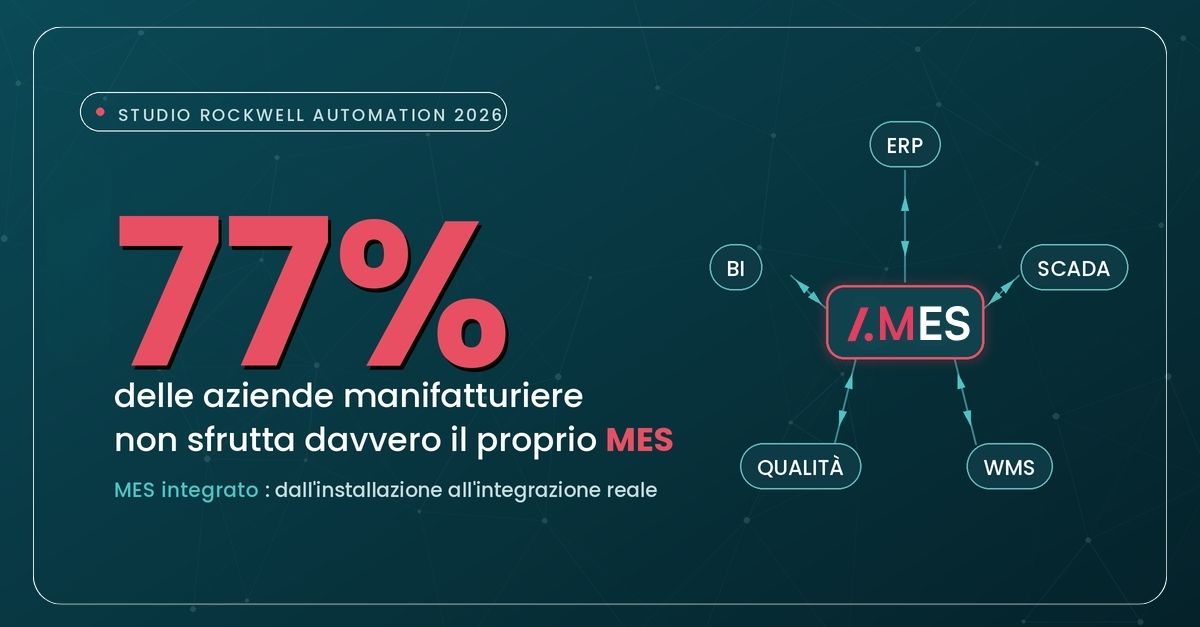
Integrated MES: Why 77% of Manufacturers Fall Short
Integrated MES: why 77% of manufacturers are not getting the value they paid for
A new global study published today by Rockwell Automation, based on responses from 1,560 operations decision-makers across 17 countries, puts a number on something most manufacturing leaders already sense: 93% of manufacturing companies have a MES running in at least one facility. Yet only 23% have fully integrated it across the enterprise.
The challenge in manufacturing digitalization has shifted. It is no longer about convincing companies to adopt a MES. It is about making the one they already have work the way it was supposed to.
If your company has a MES that is not delivering the results you expected, this article explains why that happens and what to do about it.
To understand first what a MES is and how it works, read: Software MES: what it is, how it works and what it is really for.
The finding that changes the MES conversation
For years the manufacturing technology debate focused on adoption: getting companies to move from spreadsheets and manual tracking to a structured MES. That battle is largely won. Nearly every mid-to-large manufacturer has made that investment.
The problem surfacing in the Rockwell Automation 2026 report is different and more nuanced. Having a MES installed is not the same as having it integrated. And the distance between the two is enormous in terms of real value generated.
According to the research, the main factors preventing full enterprise-wide MES integration are:
- Disconnected systems (ERP, MES, SCADA, WMS running in silos)
- Underutilized data (collected but not analyzed, or analyzed in isolation by department)
- Growing operational risk from platform heterogeneity
The result is that many companies pay for a MES license, use it in one or two departments, and continue managing the rest of production the same way they always have.
What integrated MES actually means
Installed MES
An installed MES collects production data in one or more departments, displays real-time progress and generates reports. It is already an improvement over manual management, but it remains a partial tool if it does not communicate with the rest of the business ecosystem.
The typical symptom of a non-integrated MES: production data lives in the MES, order and inventory data lives in the ERP, quality data lives in a separate system. To get a complete picture, someone has to export, cross-reference and reconcile everything manually. Usually in Excel.
Integrated MES
A fully integrated MES is connected bidirectionally with every system that touches production:
- ERP: receives production orders, returns real completion data including quantities produced, scrap, and actual cycle times
- SCADA and machines: collects real-time process data (speed, temperature, pressure, energy consumption) directly from PLCs and IoT sensors
- WMS: tracks actual material availability and updates stock levels with every movement
- Quality systems: links every non-conformity to the batch, machine, operator and process parameters that caused it
- Business Intelligence: feeds dashboards and analysis with live production data, with no manual steps
When these flows work, the MES stops being a department tool and becomes the information backbone of the entire factory.
Why 77% of companies cannot fully integrate their MES
The legacy architecture problem
Most manufacturing plants were not built on a blank canvas. They are layered environments built up over decades: machines from the 1990s running alongside 2023 IoT sensors, ERP systems installed fifteen years ago connected to MES modules added later, often from different vendors.
Each technology layer has its own protocols, data formats and operating logic. Integrating a MES into this context is not a configuration task. It is an engineering project. And many companies did not budget for it when they purchased the MES.
The over-customization problem
Many MES implementations required such deep code-level customization that every update becomes a project in itself. When the vendor releases a new version, the company must choose between upgrading and losing the customizations, or staying put and accumulating technical debt. They almost always stay put.
The result after a few years is a system that cannot be integrated with new tools because it is too closed and too expensive to modify.
The organizational silo problem
The Rockwell Automation study is explicit on this: the barrier is not only technological. Often the MES does not get integrated because production and IT do not communicate, or because each plant in a group operates independently with no centralized governance over factory technology.
A fully integrated MES requires multiple departments and roles to share data and processes. If the organization is not structured to do that, technology alone is not enough.
The scalability problem
Many companies piloted a MES successfully in one plant, then tried to replicate it across others and ran into complexity: different processes, different machines, differently configured ERPs, people accustomed to working differently.
Scaling a MES from one facility to five requires a platform designed to be modular and configurable, not a solution built specifically for a single context.
The real cost of a non-integrated MES
The direct cost of a non-integrated MES is straightforward to calculate: licenses paid for unused features, hours spent reconciling data between systems, transcription errors propagating through the production chain.
But the highest cost is opportunity cost: the value that a full integration would have generated, but does not.
Some concrete examples:
Planning based on estimates instead of real data. If the ERP does not receive updated production actuals from the MES, it plans based on theoretical standard times. The result is production plans that do not reflect what actually happens on the floor: delays discovered too late, invisible bottlenecks, customer commitments that are hard to meet.
Quality managed after the fact instead of in real time. If the MES is not connected to machine process parameters, a non-conformity is discovered at the end of a batch instead of during processing. The damage has already multiplied across hundreds of parts.
Business Intelligence fed by stale data. If the BI platform does not receive real-time data from the MES, dashboards show snapshots of the past, not the current situation. Management decisions are based on outdated information.
For a full analysis of costs and savings in a complete MES implementation, read: MES ROI: costs and savings of a production software.
How to fix it: three conditions for a truly integrated MES
1. Configurability over customization
The difference between a configurable MES and a customized one is fundamental to long-term integration capability.
A configurable MES adapts to the factory's rules and processes through internal parameters, without modifying source code. When an update arrives, the system updates without losing company configurations. When a new plant is added, the configuration is replicated quickly without redoing the work from scratch.
A customized MES carries technical debt that grows with every modification and makes every future integration more expensive and more risky.
2. Native connectors for major ERP systems
ERP integration is the most critical technical requirement of any MES implementation. A MES that does not communicate bidirectionally with the company ERP is not an integrated MES. It is an isolated data collection system.
Native connectors for major ERP platforms (SAP, Microsoft Dynamics, and others) dramatically reduce integration time and cost compared to building custom connectors. It is one of the most important criteria to evaluate when selecting a vendor.
For a complete selection guide, read: How to choose a MES software: the practical guide for manufacturers.
3. Modular architecture for real scalability
A MES designed to scale across multiple plants must be modular by nature: each facility activates the modules it needs, with configurations specific to its own processes, but on a common platform that enables centralized data governance and performance monitoring.
This is the architecture that separates the 23% with a fully integrated MES from the 77% that remain stuck.
MES vs ERP: the role of each in integration
A recurring question when discussing MES integration is its relationship with the ERP. The two systems do not overlap: they operate at different levels and complement each other.
The ERP plans what to produce and when. The MES executes, monitors and reports. When integrated, the ERP stops working on estimates and works on real data coming from the factory floor.
For a deeper look at this topic, read: MES vs ERP: differences, integration and when you need both.
/.MES by Advinser: built for integration, not isolation
/.MES was developed through years of direct implementations in Italian manufacturing, with a precise awareness: the real value of a MES is only generated when it is fully integrated with the business ecosystem.
That is why /.MES is built on three principles that directly address the problems described in this article:
Configurable, not customized. Production rules, work cycles, quality parameters and alerts are set through internal parameters without modifying source code. Every update preserves company configurations. Every new facility replicates the configuration quickly.
Integrated by design. /.MES connects with major Italian and international ERP platforms, as well as SCADA, WMS, quality systems and machinery through native connectors and open architectures. When integrated with Advinser Business Intelligence on Qlik, production data feeds dashboards and analysis in real time with no manual steps.
Modular for real scalability. Start with the most urgent module, add quality, energy, advanced planning and maintenance as the organization grows. Every plant in the group runs on the same platform, with configurations specific to its own processes.
Rubinetterie Treemme, a Tuscan company and leader in bathroom fittings, adopted /.MES to digitalize and optimize its production operations, gaining full real-time visibility on order status and dramatically faster response times on quality non-conformities.
FAQ: Integrated MES and integration challenges
Why do many companies have a MES but not use it to its full potential?
The most common reason is that the MES was implemented in isolation, without integration with the ERP and machines. In this case the system collects data but does not connect it with the rest of the business, making manual reconciliation necessary and eliminating much of the value it should deliver.
What is the difference between an installed MES and an integrated MES?
An installed MES operates in one or more departments but does not communicate with other business systems. An integrated MES is connected bidirectionally with ERP, machines, quality systems and Business Intelligence, creating a single data flow between office and factory floor with no manual steps.
How long does it take to integrate a MES with an ERP?
It depends on the quality of available connectors and the complexity of the ERP. With native connectors for common platforms such as SAP or Microsoft Dynamics, a basic integration can be completed in a few weeks. Integrations with heavily customized legacy systems require more time and a preliminary analysis of existing data flows.
Is it possible to integrate an existing MES or does it need to be replaced?
It depends on the architecture of the current system. If the existing MES is configurable and has open APIs, integration with new systems is feasible without replacement. If it was customized in a closed way and has no standard connectors, replacement may be more cost-effective than maintaining an expensive custom integration.
How many companies actually have a fully integrated MES?
According to the report "Scaling MES Across the Enterprise" by Rockwell Automation, published in July 2026 based on a sample of 1,560 operations decision-makers across 17 countries, only 23% of manufacturing companies have achieved full enterprise-wide MES integration. While 93% have a MES running in at least one facility, the majority have not been able to extend integrated adoption across the entire organization.
Does an integrated MES require upgrading the ERP?
No. A well-designed MES adapts to the existing ERP through connectors, without requiring its replacement or upgrade. The necessary condition is that the ERP exposes its data through APIs or standard protocols. The vast majority of ERP platforms used in manufacturing already support this.